Recently, Professor Biao Wang's research team published a research paper titled "Geometrically characteristic kinetic thermodynamic deformation theory and intrinsic indices of the plasticity and damage of crystalline solid" in the Journal of the Mechanics and Physics of Solids, a leading journal in the field of solid mechanics. The paper was co-authored by Professor Yichao Zhu, a visiting professor at the Center, and Professor Biao Wang, Director of the Interdisciplinary Science Center, who served as co-corresponding authors, in collaboration with researchers from Dalian University of Technology.
Accurate prediction of the full-life strength and damage of materials is of critical importance in engineering design and safety assessment. However, existing empirical models struggle to simultaneously describe complex behaviors such as plasticity, damage, and anisotropy, and often rely on extensive experimental data from multiaxial loading tests, thereby limiting their scope of engineering application.
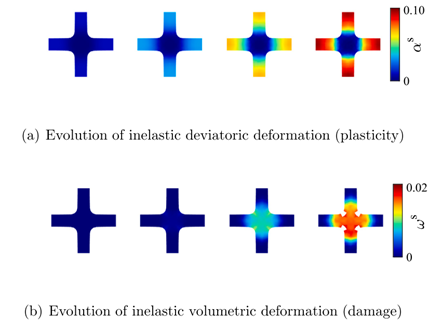
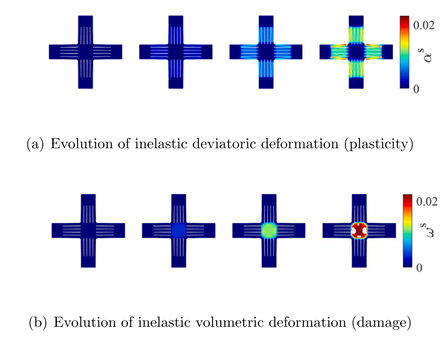
Based on the geometric characteristics of deformation, the thermodynamic deformation theory proposed by Professor Biao Wang enables accurate prediction of the full deformation process of equal-thickness and slitted "cross-shaped" specimens using only uniaxial tensile data.
Building upon the geometric characteristics of deformation, the paper advances the thermodynamic deformation theory originally proposed by Professor Biao Wang. The inelastic deformation is decomposed into a distortion mode and a dilatation mode, each possessing clear geometric and physical significance. The theory incorporates the kinetic mechanism by which microstructural evolution is hindered by local energy barriers, and proposes two classes of intrinsic indices characterizing the resistance to inelastic deformation in materials. The paper presents a standardized inversion procedure: requiring only a single uniaxial tensile curve, it enables the prediction of full-life responses under complex loading conditions, including cyclic loading, biaxial stress concentration in cross-shaped specimens, and stress concentration in slotted specimens. The simulation results are in good agreement with experimental observations. In contrast to conventional ductile damage models that necessarily depend on triaxiality experiments, this theory offers a rigorous physical foundation along with practical convenience for engineering applications.
The theory can be further extended to finite deformation and multi-field coupling scenarios, and holds promise for providing a unified thermodynamic framework for the full-life reliability design of metallic structures under extreme environments such as elevated temperatures and high irradiation.
Original Reference: Liu J, Ma C, Zhu Y, Wang B. Geometrically characteristic kinetic thermodynamic deformation theory and intrinsic indices of the plasticity and damage of crystalline solid[J]. Journal of the Mechanics and Physics of Solids, 2025, 200: 106139.