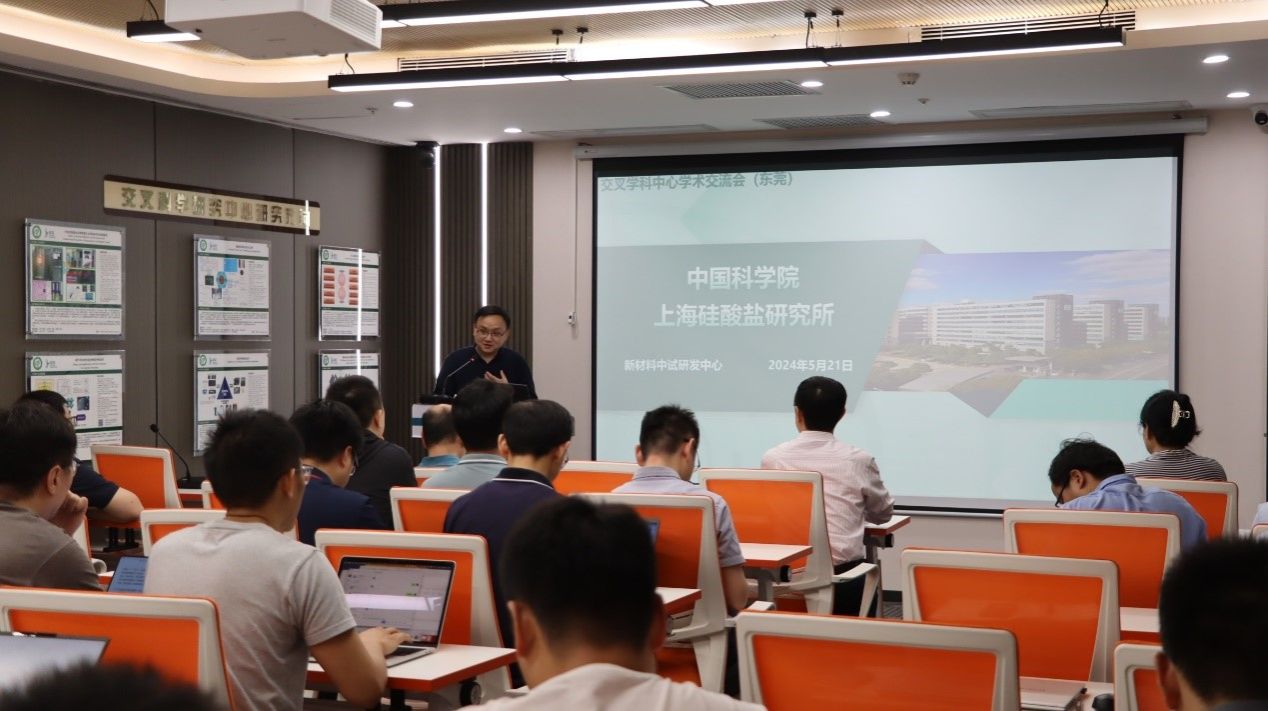
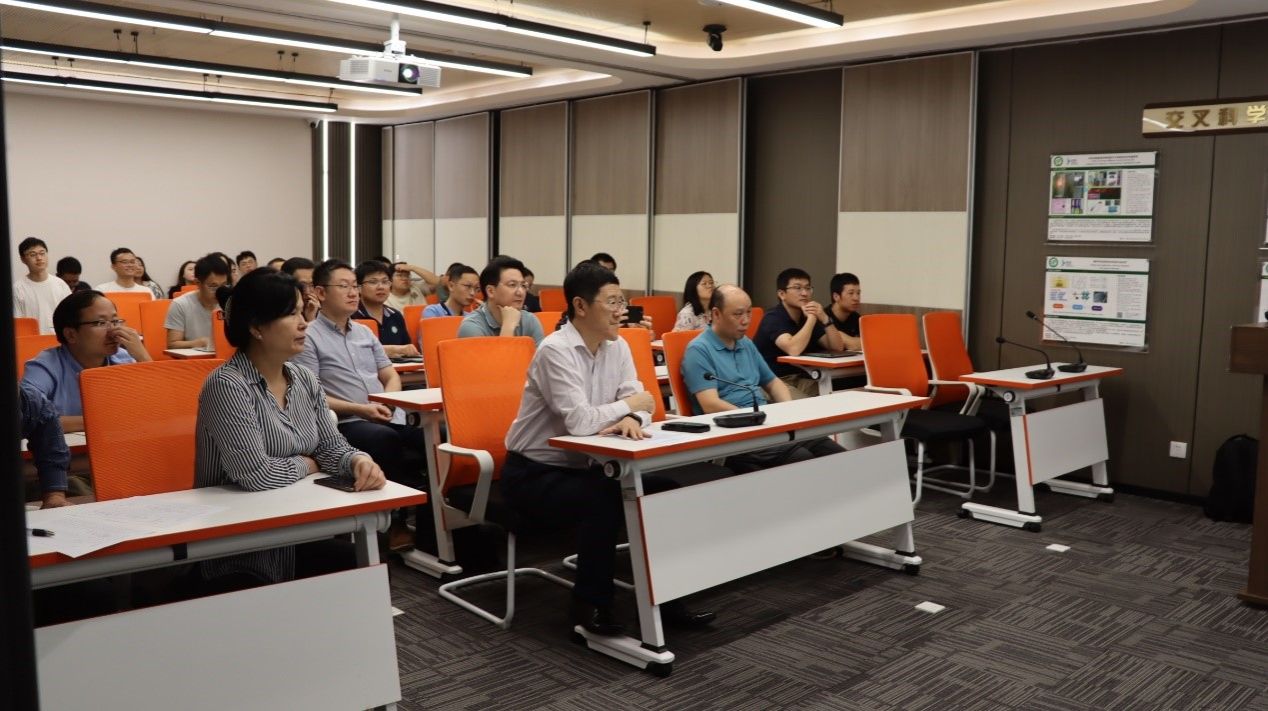
On the evening of May 21, 2024, Professor Ding Dongzhou from the Pilot Research and Development Center for New Materials of the Shanghai Institute of Ceramics, Chinese Academy of Sciences, visited DGUT by invitation and delivered an excellent academic report titled "Inorganic Scintillation Crystals" in Conference Room A10 of the Interdisciplinary Science Research Center. The session was chaired by Professor Wang Biao of the School of Materials Science and Engineering and attracted active participation from dozens of faculty members and students from the school and other related units.
During the session, Professor Ding began by reviewing the history of inorganic scintillation crystals and their applications, and introduced the latest frontier advances. He explored the key scientific and technological issues that urgently need to be addressed for future development, covering aspects such as the synergistic optimization mechanisms of scintillation performance, the influencing factors and action mechanisms of rise time, and the preparation science of micro-, meso-, and macro-scale relationships. His presentation aimed to present a comprehensive overview of the development of inorganic scintillation crystals. From the perspective of structure-property relationships, he also shared his team's research progress in the field of rare-earth oxide scintillation crystals. After the report, Professor Ding engaged in lively discussions with the attendees, providing detailed answers to the questions raised, which enabled the faculty and students present to gain a deeper understanding and appreciation of the topics covered.
With its rich content and accessible explanations, the report successfully broadened the attendees' intellectual horizons and, in a subtle yet powerful way, ignited their enthusiasm and dedication toward scientific research. The event was not only a complete success but also infused the school's academic exchanges with vibrant vitality and sustained momentum, fostering the vigorous development of the academic atmosphere.
Biography:
Ding Dongzhou, Ph.D., Senior Engineer (Professor-level), Doctoral Supervisor, and Chief Scientist of a National Key Research and Development Program project. He currently serves as Deputy Director of the Pilot Research and Development Center for New Materials at the Shanghai Institute of Ceramics, Chinese Academy of Sciences, and Head of the Rare-Earth Oxide Scintillation Crystal Research Group. He was selected into the Key Technology Talent Program of the Chinese Academy of Sciences (2017) and appointed as a Distinguished Core Researcher of the Chinese Academy of Sciences (2022). Professor Ding serves as Chair of the Optical Crystal Standardization Committee of the Chinese Society for Testing and Materials (CSTM), and as a member of the Photoelectric Materials Committee, the Synthetic Crystal Technology Committee, and the Photoelectric Detection Technology Committee. He is also a member of the Rare-Earth Crystal Professional Committee of the Chinese Rare Earth Society, a technical expert for the National New Material Testing and Evaluation Platform's Advanced Inorganic Non-metallic Materials Industry Center and the Rare-Earth Industry Center, an editorial board member of the Journal of Synthetic Crystals, and a youth editorial board member of the Chinese Journal of Luminescence.
The research team led by Professor Ding has long been dedicated to the study of high-performance rare-earth oxide scintillation crystals, accumulating extensive research experience in the local structure design of scintillation crystals, luminescence mechanism investigations, crystal growth, and device development. The team has published over 80 academic papers in leading journals in the field, including Crystal Growth & Design, CrystEngComm, Journal of Solid State Chemistry, Journal of Luminescence, Applied Physics Letters, Journal of Applied Physics, Physica Status Solidi B, IEEE Transactions on Nuclear Science, Nuclear Instruments and Methods in Physics Research A, among others. They have filed 24 patent applications, including 12 granted in China and 1 granted in the United States, and have led the formulation and release of 7 scintillation crystal-related standards. The scintillation crystals developed under their leadership have achieved cutting-edge applications.
Written by: Tan Tingyuan
First Review: Liu Zhao / Second Review: Li Runxia / Third Review: Wang Biao