In the field of energetic materials, intermolecular interactions are a central research focus, as they govern key properties such as energy storage, energy release, and stability of explosives and related materials. Wang Biao and Professor Sun Changqing's team from the Interdisciplinary Science Research Center published their latest research findings in The Journal of Physical Chemistry Letters, a top-tier international journal in physical chemistry. The article, titled "Discriminative Mechanical and Thermal Response of the H–N Bonds for the Energetic LLM-105 Molecular Assembly," was co-completed by Dongguan University of Technology, Sun Yat-sen University, and the China Academy of Engineering Physics. Doctoral student Wang Jushan is the first author, with Professor Wang Biao, Professor Yang Yanqiang, and Professor Sun Changqing as co-corresponding authors.
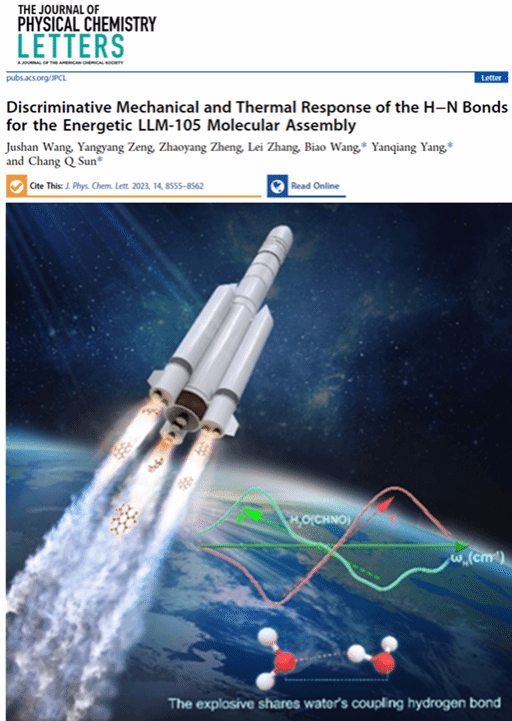
Key findings: (1) The LLM-105 explosive shares coupled hydrogen bonds O:H–O/N with water; both H–O/N covalent segments exhibit negative thermal expansion coefficients and negative compressibility coefficients, conforming to the scaling rules of Hydrogen-Bond Cooperative Polarization (HBCP) for coupled hydrogen bonds; (2) H–N dangling bonds exhibit elevated vibrational frequencies due to their conformity to the universal Bond-Order-Length-Strength (BOLS-NEP) scaling rules for undercoordinated bond contraction; (3) Due to the absence of coupling effects, the two-body H–N dangling bonds display conventional positive compressibility coefficients and thermal expansion coefficients. This study not only enriches our understanding of the molecular assembly characteristics of LLM-105 but also provides a solid foundation for exploring molecular interactions in energetic materials, particularly in emerging domains involving lone electron pairs or dipole–dipole interactions.
Article link: https://pubs.acs.org/doi/10.1021/acs.jpclett.3c01943

First draft: Zhou Yong, Zhang Chenxu; First review: Liu Zhao; Second review: Li Runxia; Final review: Wang Biao