Recently, Associate Researcher Heng Chen published a research paper titled "Multicomponent chitosan complex/polyvinyl alcohol blended film with full-band UV-shielding performance and excellent antioxidant property for active food packaging" in Carbohydrate Polymers (IF = 11.2, CAS Q1, TOP journal), a leading journal in the field of glycoscience. The primary affiliating institution of this paper is Dongguan University of Technology, with collaborating institutions including Songshan Lake Materials Laboratory, Changzhi Medical College, and Zhejiang University School of Medicine. The corresponding authors are Professor Biao Wang from Dongguan University of Technology, Researcher Jianbin Xu from Zhejiang University School of Medicine, and Researcher Xin Wang from Songshan Lake Materials Laboratory.
Food packaging consumes vast quantities of plastic products on a daily basis, contributing to the escalating depletion of petroleum resources while simultaneously causing severe environmental pollution. This pressing issue has driven the research focus of packaging materials toward bioplastics derived from renewable resources such as polysaccharides. Chitosan, a natural cationic polysaccharide obtainable through the deacetylation of chitin, possesses numerous advantageous properties, including biodegradability, non-toxicity, film-forming ability, antimicrobial activity, and chelating capacity. Consequently, the application of chitosan in food packaging materials has garnered increasing attention from both academia and industry.
Food products are typically composed of organic biological raw materials. With prolonged storage time, food undergoes gradual spoilage through oxidative reactions of lipids and proteins. To preserve food quality, it is essential to develop antioxidant active packaging materials capable of inhibiting these oxidative reactions. Moreover, exposure to sunlight, particularly ultraviolet radiation, substantially accelerates the oxidative deterioration of food. Therefore, enhancing the UV-shielding performance of materials should also be taken into consideration when designing antioxidant active packaging materials. Currently, most antioxidants and UV absorbers exhibit poor water solubility, rendering the modification of chitosan with these agents particularly challenging.
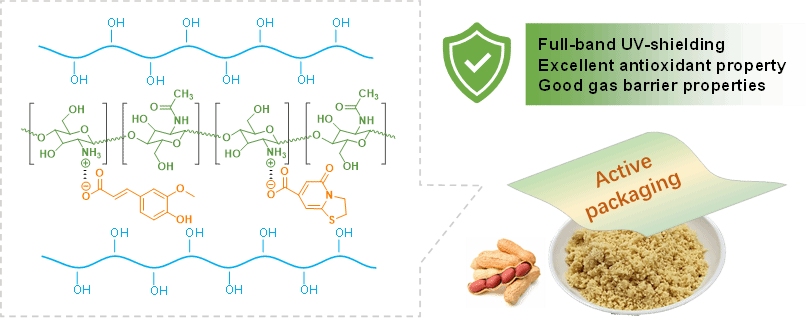
In this study, multicomponent chitosan complexes were blended with polyvinyl alcohol to fabricate transparent films featuring full-band UV-shielding and antioxidant properties, which were successfully applied to peanut preservation. Specifically, chitosan, ferulic acid, and thiazolopyridine acid were combined through thermal-assisted synthesis to generate the multicomponent chitosan complex, which was subsequently blended with polyvinyl alcohol and subjected to solvent evaporation to yield the transparent blended film. The combination of the robust UV absorption capabilities of ferulic acid and thiazolopyridine acid endows the blended film with nearly full-band UV absorption characteristics. Additionally, the phenolic hydroxyl groups of ferulic acid confer strong antioxidant properties upon the blended film. In a 30-day accelerated oxidation test under UV irradiation, this chitosan complex/polyvinyl alcohol blended film demonstrated effective protective properties against the oxidative deterioration of peanut butter. This work validates the feasibility of constructing multifunctional active food packaging materials using multicomponent chitosan complexes, and holds promise for advancing the large-scale application of chitosan-based functional materials in fields such as food packaging, pharmaceuticals, and cosmetics.
This work was supported by the National Natural Science Foundation of China (Youth Fund Project, No. 52103059), the Guangdong Basic and Applied Basic Research Foundation (Youth Fund Project, No. 2019A1515110433), and the Shenzhen Basic Research General Project (No. JCYJ20190808123207674).
Original Article: https://www.sciencedirect.com/science/article/abs/pii/S0144861723011700
First Draft: Heng Chen | First Review: Zhao Liu | Second Review: Runxia Li | Final Review: Biao Wang