Distinguished Researcher Chen Muqing from the School of Materials Science and Engineering at Dongguan University of Technology, in collaboration with Professor Du Pingwu from the University of Science and Technology of China and Professor Zhu Yihan from Zhejiang University of Technology, has developed the first curved carbon nanocoil material featuring nitrogen-doped Riemann surfaces, filling a gap in the field of nitrogen heteroatom-doped curved carbon helical materials. Recently, this research achievement was published in the Nature subsidiary journal Nature Communications, with the School of Materials Science and Engineering at Dongguan University of Technology as the first affiliation.
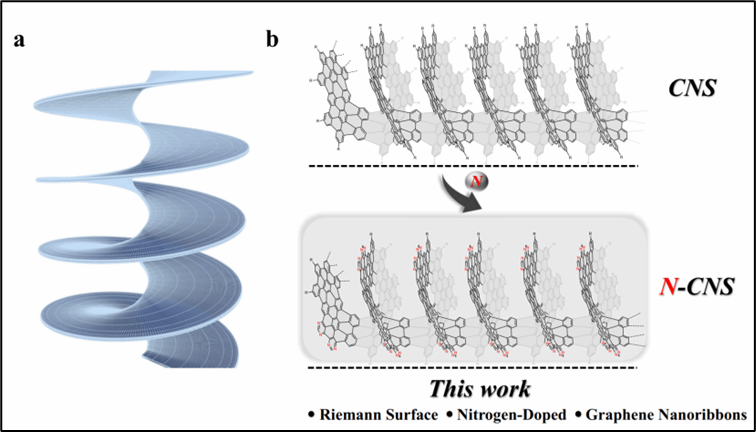
Figure 1. (a) Schematic illustration of a carbon nanocoil; (b) Design of a π-extended N-doped nanocarbon coil.
Molecular-based carbon materials have attracted considerable attention due to their unique geometric configurations and physicochemical properties, including electrical conductivity, excellent visible light absorption, and luminescence. A graphene sheet continuously spiraling around an axis perpendicular to its basal plane can form a three-dimensional structure with a Riemann surface (Figure 1). Theoretical predictions suggest that carbon coils with Riemann-surface-like geometries can function as quantum conductors, generating substantial magnetic fields and inductance when a voltage is applied. Carbon nanocoil materials with Riemann surfaces are predicted to possess distinctive structures and novel physical properties. However, realizing such helical topologies with extended conjugation represents a significant challenge, which has stimulated considerable interest among chemists in designing and synthesizing these multidimensional curved carbon architectures.
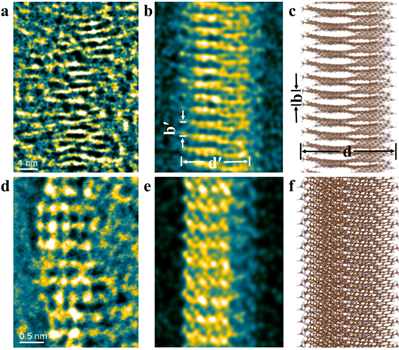
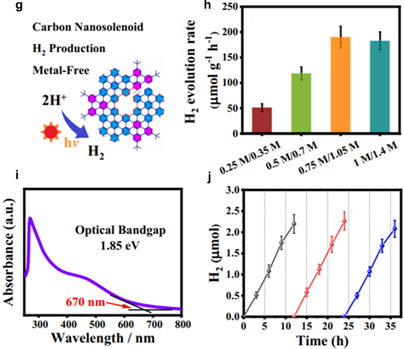
Figure 2. iDPC-STEM characterization of N-CNS.
This research achievement marks the first bottom-up synthesis of nitrogen-doped carbon nanocoil materials (N-CNS) with well-defined structures. N-CNS was obtained through rational Suzuki polymerization followed by oxidative cyclodehydrogenation. The successful synthesis of N-CNS was thoroughly characterized using GPC, FTIR, solid-state ¹³C NMR, and Raman spectroscopy. Low-dose integrated differential phase-contrast scanning transmission electron microscopy (iDPC-STEM) was employed to clearly resolve the intrinsic molecular structure of the N-CNS helix (Figures 2a–2f), while the photocatalytic hydrogen evolution (Figures 2g–2j) and catalytic organic reaction performance of this novel class of nitrogen-doped carbon coil materials were also investigated. This accomplishment expands the scope of functional curved carbon nanomaterials and provides an experimental foundation for the future development of carbon coil materials with diverse unique functionalities. (Related article link:
https://doi.org/10.1038/s41467-023-41467-4)
It is noted that Researcher Chen Muqing is currently a member of Professor Qiu Yongfu's research team. Over the past three years, this team has published a series of high-level SCI papers with Dongguan University of Technology as the first affiliation in the field of novel materials (including Nature Communications, Journal of Materials Chemistry A, Chemical Science, Inorganic Chemistry Frontiers, Chinese Journal of Chemistry, Nanomaterials, among others), and has been granted two General Programs from the National Natural Science Foundation of China and one Cultivation Project from the Guangdong-Dongguan Joint Fund.
(First draft: Chen Muqing; First review: Yang Zhuangpeng; Second review: Li Runxia; Final review: Chen Baohua)