Recently, Dr. Wen Donghui, a postdoctoral researcher at the Interdisciplinary Science Research Center of Dongguan University of Technology, conducted a study on phase precipitation and high-temperature oxidation resistance behavior in FexCrNi medium-entropy alloys. The related findings were published in the journal Journal of Alloys and Compounds under the title "Supersaturation and dissolvable α-Cr phase enable superior oxidation resistance in FeCrNi medium-entropy alloys" (DOI: 10.1016/j.jallcom.2023.170216). The corresponding authors are Researcher Wang Anding and Professor Wang Biao from the Interdisciplinary Science Research Center.
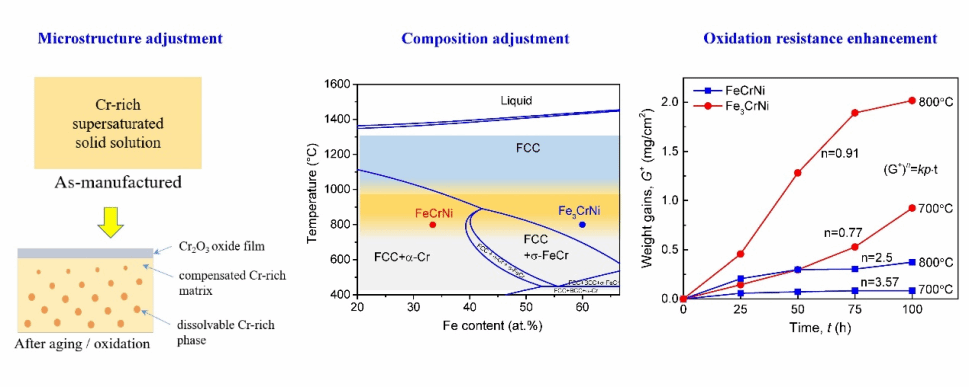
For Fe-based alloys, increasing Cr content generally enhances oxidation and corrosion resistance; however, excessive Cr addition promotes the precipitation of substantial Cr-rich phases such as σ-FeCr and Cr₂₃C₆ at grain boundaries, resulting in intergranular brittle fracture and intergranular corrosion. Moreover, the substantial consumption of Cr further degrades the alloy's oxidation resistance. Therefore, novel alloy design strategies are required to regulate the microstructure of high-Cr-content Fe-based alloys.
The design strategy of medium-/high-entropy alloys offers promising potential for achieving single-phase solid solution microstructures in alloys with high solute contents. In this work, the CALPHAD method was employed to design FeCrNi and Fe₃CrNi alloys with two typical distinct microstructures, and their phase precipitation and high-temperature oxidation resistance behavior were systematically investigated. The results indicate that the FeCrNi alloy precipitates α-Cr phase due to its high Cr content; however, the high-entropy effect suppresses the precipitation of σ-FeCr phase. Although α-Cr also consumes Cr elements from the matrix, the α-Cr phase can decompose during high-temperature oxidation, continuously providing the necessary Cr elements for the formation of Cr₂O₃ oxide scale, thereby ensuring the long-term oxidation resistance of the alloy. In contrast, the Fe₃CrNi alloy with lower Cr content formed a composite Cr₂O₃+Fe₂O₃ oxide scale, leading to a significant deterioration in oxidation resistance. This discovery provides new insights for the development of novel heat-resistant stainless materials.
This work was supported by the National Natural Science Foundation of China (Grant Nos. 52201175, 52101130), the Guangdong Basic and Applied Basic Research Foundation (No. 2019A1515110051), and the NSFC Original Exploration Program (12150001).
First draft: Wen Donghui; First review: Liu Zhao; Second review: Li Runxia; Final review: Wang Biao