Recently, Associate Researcher Wei Wensen from the Interdisciplinary Science Research Center at Dongguan University of Technology, in collaboration with the High Magnetic Field Laboratory of the Hefei Institutes of Physical Science (Chinese Academy of Sciences), the Deep Space Exploration Laboratory, and the Beihang University Hefei Research Institute, conducted a study on the magnetic phase transition critical behavior of the antiskyrmion material Mn₂Rh₀.₉₅Ir₀.₀₅Sn. The related findings were published as a research article in the journal Journal of Alloys and Compounds (DOI: 10.1016/j.jallcom.2023.169299). Wei Wensen is the first author, with Dongguan University of Technology as the first completing institution. The corresponding authors are Associate Researcher Zu Lin from the Hefei Deep Space Exploration Laboratory and Professor Wang Biao.
Magnetic skyrmions are a class of topologically nontrivial vortex-like spin textures characterized by nonzero topological charge numbers, arising primarily from competing interactions—including Heisenberg exchange interaction, Dzyaloshinskii–Moriya (DM) interaction, and Zeeman energy—in non-centrosymmetric materials. Magnetic antiskyrmions are also a class of topologically nontrivial vortex-like spin textures, possessing topological charge numbers equal in magnitude but opposite in sign to those of magnetic skyrmions. Research has revealed that the formation mechanisms of antiskyrmions differ considerably from those of skyrmions: antiskyrmion formation often depends on anisotropic DM interactions, with magnetic dipole interactions also playing a significant role.
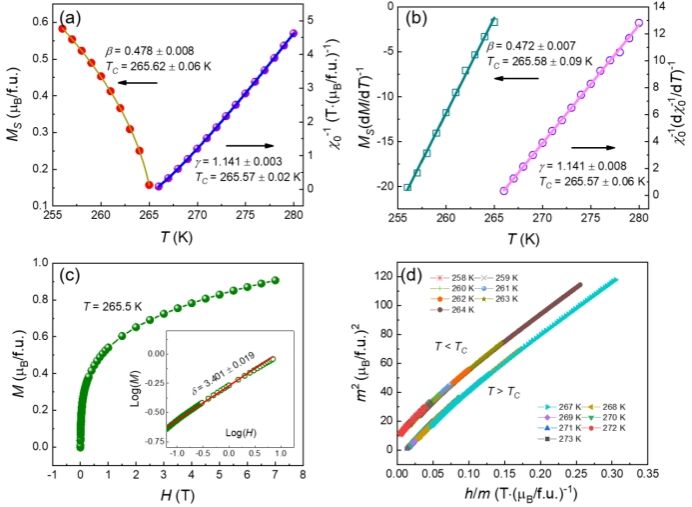
Magnetic phase transitions are closely related to magnetic interactions. In this work, we investigated the critical behavior of magnetic phase transitions in the antiskyrmion material Mn₂Rh₀.₉₅Ir₀.₀₅Sn. We focused on measuring magnetization curves near the phase transition region, employing iterative methods including the modified Arrott plot method (Figure a), the Kouvel–Fisher plot method (Figure b), and critical temperature spontaneous magnetization curve fitting (Figure c) to obtain the critical exponents of the antiskyrmion material Mn₂Rh₀.₉₅Ir₀.₀₅Sn. These exponents conform to scaling relations and mutually corroborate one another. Applying these exponents, the reduced magnetization curves of the material were separated into two branches—one for T < Tc and another for T > Tc—further confirming the validity of these exponents (Figure d). The derived critical exponents β, γ, and δ (Figures a–c) indicate that the antiskyrmion material Mn₂Rh₀.₉₅Ir₀.₀₅Sn exhibits critical behavior approximating the Landau mean-field form. The slowly decaying magnetic interactions inferred from the critical exponents demonstrate markedly distinct characteristics from those of most skyrmion materials, potentially related to anisotropic DM interactions within the system.
This work was supported by the National Natural Science Foundation of China (Grant Nos. 11904368, 12004023, 11832019, 12150001), the Anhui Provincial Natural Science Foundation (2008085QA32), and the Beihang University Hefei Innovation Research Institute Fund Project (BHKX-19-02).
First draft: Wei Wensen; First review: Liu Zhao; Second review: Li Runxia; Final review: Wang Biao