Recently, Assistant Researcher Chen Bin published a research article titled "Experimental validation of the thermodynamic theory for predicting the strength of 6061 Al alloy with complex loadings" in the authoritative journal
Engineering Fracture Mechanics (DOI:
https://doi.org/10.1016/j.engfracmech.2022.109006). The corresponding authors are Professor Li Runxia and Professor Wang Biao.
Safety has always been a paramount concern in engineering structural design. Although nearly all engineering designs adhere to safety codes, safety incidents still occur from time to time. Numerous factors contribute to this situation, with the most critical being the difficulty in accurately determining the fracture strength of material structures. For a long time, the determination of material structural strength has relied on empirical strength criteria. While specimen deformation and stress distributions can be obtained through numerical methods such as the finite element method, structural safety is ultimately determined by empirical strength criteria. Furthermore, because these criteria are empirical and loading conditions for material structures are complex, relatively large safety factors must be adopted to ensure safety, resulting in substantial material waste and energy consumption. Therefore, regarding the fracture and failure of engineering material structures, is it possible to develop rigorous scientific predictive theories to replace empirical formulas? In recent years, Professor Wang Biao proposed a unified thermodynamic theory for predicting the strength of material structures (Eng Fract Mech., 2021, 254: 107936), providing new insights for addressing the aforementioned challenges.
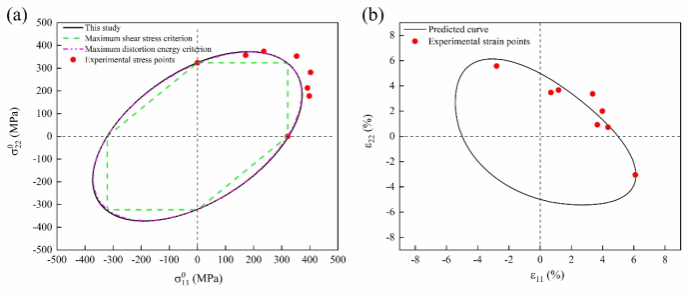
The objective of this work is to validate the theory proposed by Professor Wang Biao. Taking 6061 aluminum alloy as the subject, uniaxial and biaxial tensile experimental schemes were designed to accurately obtain the fracture strength under different loading conditions. The overall theoretical modeling approach treats the plastic deformation of the system and its overall average misfit as eigenstrains, deriving the change in Gibbs free energy caused by the introduction of plastic deformation under specific loading conditions. Based on nonequilibrium thermodynamics, the evolution equation for plastic deformation perturbation is derived, and the steady-state condition for plastic deformation and the critical condition for fracture are obtained. The expansion coefficients of the plastic dissipation energy density function were determined through uniaxial and equibiaxial tensile tests. Finally, the fracture strength of 6061 aluminum alloy in stress space and strain space was predicted, showing excellent agreement with experimental results. Additionally, the theoretical predictions of this work were compared with results from two classical strength theories (the maximum shear stress theory and the maximum distortion energy theory). This study validates the accuracy and reliability of the unified thermodynamic theory for predicting material structural strength, laying the foundation for its application in engineering fields.
This work was supported by the National Natural Science Foundation of China Original Exploration Program (12150001), General Program (51974092), Young Scientists Fund (12002401), and the National Defense Science and Technology Industry Nuclear Power Technology Innovation Center Project (HDLCXZX-2021-HD-035).
First draft: Chen Jiapeng; First review: Liu Zhao; Second review: Li Runxia; Final review: Wang Biao