Recently, Associate Researcher Chen Heng published a research article titled "Thermal-assisted synthesis of ferulic acid-chitosan complex in water and its application as safe antioxidant" in International Journal of Biological Macromolecules (IF = 8.025, CAS Q1, TOP journal) (DOI: https://doi.org/10.1016/j.ijbiomac.2022.12.184). Dongguan University of Technology is the first completing institution, with Researcher Wang Xin from the Songshan Lake Materials Laboratory as the corresponding author. Collaborating institutions include the Songshan Lake Materials Laboratory, Changzhi Medical College, and the School of Medicine at Zhejiang University.
Free radicals are widely present in various chemical reactions and biological systems, exhibiting extremely high reactivity and instability. In organisms, free radicals can readily damage nucleic acids, proteins, carbohydrates, and lipids, causing a series of detrimental effects such as aging, diseases, and spoilage. Antioxidants can effectively scavenge free radicals by inhibiting their formation and have been extensively utilized in the cosmetics, pharmaceutical, and food industries. Currently, synthetic antioxidants such as butylated hydroxytoluene, butylated hydroxyanisole, and tert-butylhydroquinone pose potential health hazards, and their use is subject to stringent regulation. Therefore, exploring unmodified or minimally modified bio-based alternatives from nature represents a promising approach for developing safe antioxidants.
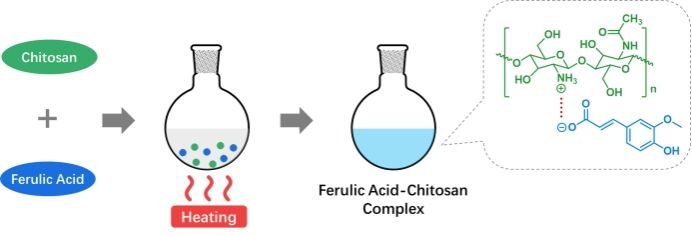
In this work, we report for the first time a method for successfully preparing a chitosan–ferulic acid complex in aqueous solution. By heating chitosan and ferulic acid in water above 80°C, the chitosan–ferulic acid complex can be obtained without the addition of any extra catalysts or cosolvents. This thermal-assisted synthesis method ingeniously overcomes the solubility challenges of chitosan and ferulic acid, bringing considerable convenience to the modification and application of these materials. The article presents a detailed investigation of the chemical structure, thermal stability, antioxidant activity, and cytotoxicity of the chitosan–ferulic acid complex. MTT assays demonstrate that the complex exhibits very low cytotoxicity, while ABTS assays reveal that it possesses higher antioxidant capacity than ferulic acid itself. Subsequently, we successfully applied this complex as a safe antioxidant in the preservation of fresh apple juice. Owing to its simple preparation method, excellent water solubility, and outstanding antioxidant performance, the chitosan–ferulic acid complex shows promise for large-scale applications in food, cosmetics, and pharmaceutical fields.
This work was supported by the National Natural Science Foundation of China Young Scientists Fund (52103059), the Guangdong Basic and Applied Basic Research Foundation Young Scientists Fund (2019A1515110433), and the Shenzhen Basic Research General Program (JCYJ20190808123207674).
First draft: Chen Heng; First review: Liu Zhao; Second review: Li Runxia; Final review: Wang Biao