Recently, Professor Sun Changqing from the Interdisciplinary Science Research Center was invited to publish research findings on the physical mechanisms underlying the anomalous properties of ice and water in Physics Reports, a top-tier international journal in physics, as the first author. Meanwhile, Dr. Zhou Yong was invited to publish research findings on multi-field perturbation phonon spectroscopy in Advances in Colloid and Interface Science, a top-tier international journal in colloid chemistry, as the first author. Dongguan University of Technology is the first completing institution for both articles.
It is noted that Physics Reports exclusively invites distinguished scholars in the field to write review articles on important advances and forward-looking perspectives in relevant areas. With only one article published per weekly volume, the journal has an impact factor of 30.51. Advances in Colloid and Interface Science has an impact factor of 15.2.
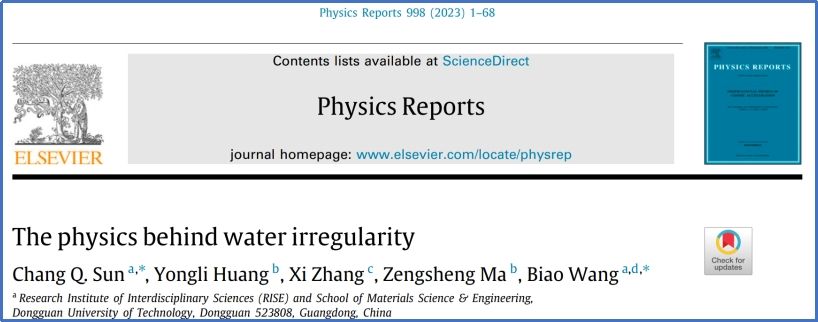
Water is the foundation of survival and the source of all things, yet all its physical properties are anomalous. The renowned philosopher and humanist Loren Eiseley observed that if there is any magic on this planet, it must reside in water. In commemoration of its 125th anniversary, Science magazine listed the structure of water as one of the 125 most challenging questions facing humanity. A recent article in Reviews of Modern Physics also indicated that as resources invested have increased and research has deepened, the number of questions generated has grown, cognitive disagreements have intensified, and debates have become increasingly fierce. The mystique surrounding water remains prevalent, with several authorities even asserting that "no one can truly ever know water!"
Building upon the work of predecessors, the research team transformed thinking and methodological approaches, achieved breakthroughs from the source, simplified complexity, and eliminated falsehoods to attain a series of substantive advances. The Physics Reports review, totaling nearly 50,000 words, primarily covers: (1) the new theory and scaling rules of three-body coupled hydrogen bond cooperative polarization and relaxation; (2) new thinking regarding improved coordinate systems and parameter spaces; (3) new methods of metrological perturbation spectroscopy; (4) new discoveries including super-hydrogen bonds, anti-hydrogen bonds, thermally induced quasi-solid states, and polarized supersolid states; (5) new quantitative and universal solutions regarding water structure, floating ice, regelation, ice lubrication, surface premelting of ice, and pressure-induced melting and hot-water cooling; and (6) new insights into energy exchange modes and rates during phase transitions and transport processes. The Advances in Colloid and Interface Science review focuses on perturbative phonon spectroscopy methods to investigate the cooperative relaxation and electronic polarization of segmental length, energy, vibrational frequency, and specific heat functions of coupled hydrogen bonds under external field perturbations including mechanical force, temperature, electric fields, and coordination, thereby establishing correlations and scaling rules between the macroscopic measurable properties of ice and water and these microscopic parameters.
Four achievements—pressure-induced hydrogen bond symmetrization, supersolidity of ice and water skins, superlubricity of ice, and hot-water cooling—have attracted considerable interest from professional media including Physics World, Physics Today, Chemistry World, Chemical Watch, Nature Chemistry, and New Scientist, which conducted multiple interviews. The coverage was subsequently reprinted by over 200 news media outlets, including Time (USA), The Wall Street Journal (USA), Daily Mail (UK), El Mundo (Spain), and Reference News (China).
This series of disruptive and original research practices has not only opened a new interdisciplinary research direction integrating ice-water, solutions, and molecular crystals such as explosives—broadly defined coupled hydrogen bond physics and mechanics—but also provided theoretical references and scaling detection methods for the deep processing of liquid water and the systematic understanding of substances containing lone electron pairs, such as catalytic superconductors and life processes.
Both studies were supported by the National Natural Science Foundation of China.
CQ Sun, YL Huang, X Zhang, ZS Ma, B Wang, The Physics behind water irregularity, Phys Rep 998, 2023, 0-67. DOI: 10.1016/j.physrep.2022.11.001
Y Zhou, L Li, YL Huang, JF Ou, W Li, HX Fang, CQ Sun, B Wang, Perturbative vibration of the coupled hydrogen-bond (O:H–O) in water, Adv Colloid Interf Sci 310, 2022, 102809. DOI: 10.1016/j.cis.2022.102809
Contributed by: Fang Hengxin, Zhang Chenxu; First review: Sun Changqing; Second review: Liu Zhao; Final review: Li Runxia