On the afternoon of November 5, 2023, Professor Liu Ming from Fuzhou University was invited to DGUT for academic exchanges and delivered an academic report titled "Characterizing the Mechanical Properties of Materials Using Instrumented Indentation and Scratch Testing." The session was held in Conference Room A10 of the Interdisciplinary Science Research Center and was chaired by Professor Li Runxia, Vice Dean of the School of Materials Science and Engineering. The report was conducted in a hybrid format combining online and in-person participation, with dozens of faculty members and students from the School of Materials Science and Engineering, the School of Mechanical Engineering, and other units attending.
During the session, Professor Liu Ming provided a detailed explanation of the domestic and international development history of instrumented indentation and scratch testing methods for characterizing mechanical properties, as well as the establishment of relevant international standards, which have brought transformative impact to the field of mechanical property testing. Focusing on the analysis and application of instrumented scratch methods, he introduced the use of instrumented scratch testing to characterize the fracture toughness of hard and brittle materials, the yield strength of metallic materials, and coating damage, and explained the influence of indenter geometry, surface inclination, and other factors on scratch testing. He explored the relationships between various measured quantities during the scratch process—such as scratch hardness, scratch hardness, lateral hardness, and elastic recovery rate—and the mechanical properties of materials, and discussed the application scope and limitations of various mechanical models. In addition, he demonstrated the registration and use of related test data processing software.
The presentation was delivered in a clear and accessible manner, providing inspiration and ideas for the research work of faculty members and students, and arousing widespread interest among the attendees. After the report, Professor Liu Ming engaged in discussions with the participating faculty and students on relevant academic topics.
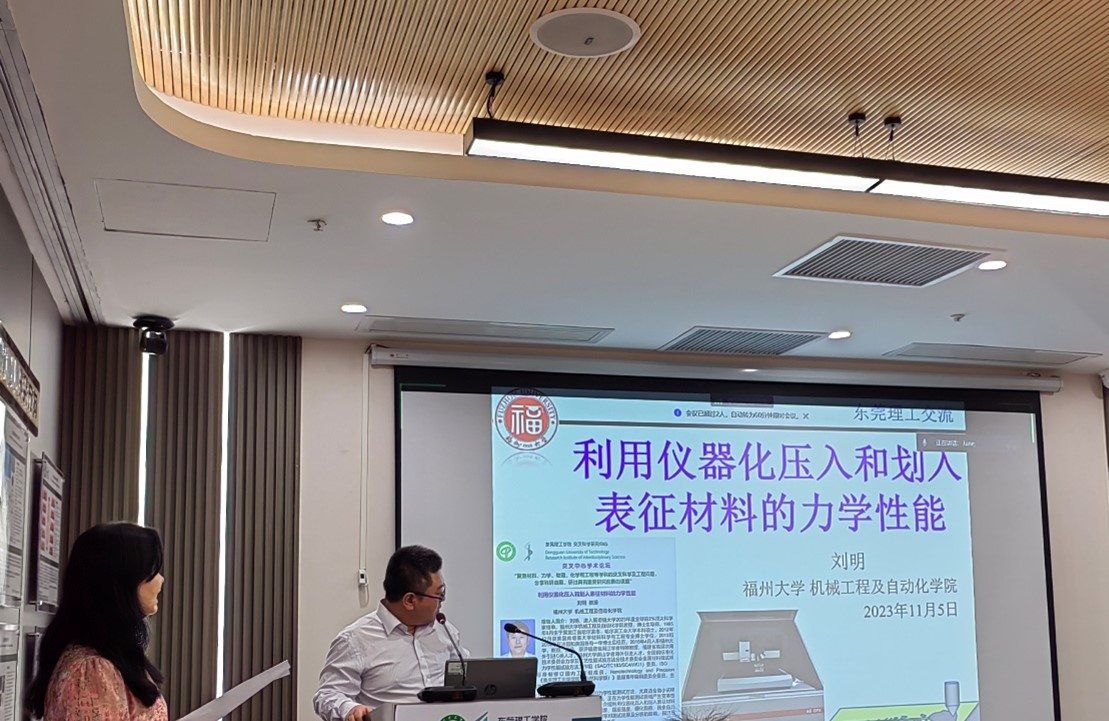
Professor Liu Ming's Introduction:
Professor Liu Ming is listed among Stanford University's 2023 World's Top 2% Scientists. He serves as a professor and doctoral supervisor at the School of Mechanical Engineering and Automation, Fuzhou University. Born in June 1985 in Harbin, Heilongjiang Province, he received his bachelor's and master's degrees from Harbin Institute of Technology, and earned his Ph.D. in Materials Science and Engineering from the University of Kentucky, USA, in December 2012. He conducted postdoctoral research for one year in France (2013) and one year in the United States (2014) before joining Fuzhou University in April 2015 as a professor and doctoral supervisor. Professor Liu has been recognized as a Minjiang Scholar Distinguished Professor of Fujian Province, a Fujian Provincial High-Level Overseas Talent (Category C), and a Qishan Scholar Overseas Talent of Fuzhou University. He serves as a member of the Working Group on Mechanical Testing Methods for Micro-Specimens of Metallic Materials (SAC/TC183/SC4/WG1) under the Subcommittee on Mechanical and Technological Properties Testing Methods of the National Steel Standardization Technical Committee, and is a member of the domestic working group for the revision of the ISO 14577 series international standards. He is also an editorial board member of Nanotechnology and Precision Engineering and a member of the inaugural Youth Editorial Board of the Journal of Chongqing University of Technology (Natural Science Edition). His research focuses on surface micro-mechanics and indentation and scratch testing methods.
Draft: Zhang Jingfeng
First Review: Liu Zhao / Second Review: Li Runxia / Third Review: Wang Biao