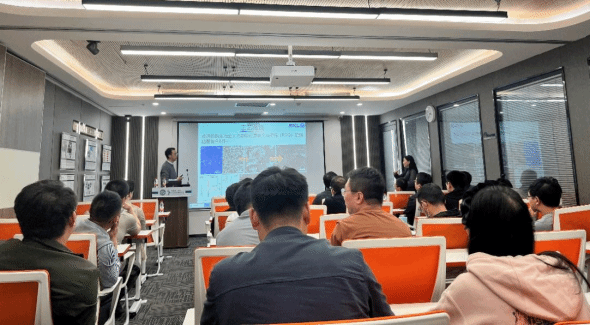
On March 28, Professor Guo Qiang from the State Key Laboratory of Metal Matrix Composites at Shanghai Jiao Tong University visited the School of Materials Science and Engineering for academic exchanges and delivered an academic report titled "Deformation Mechanisms and Interfacial Effects in Graphene-Reinforced Metal Matrix Composites" in Conference Room A10 of the Interdisciplinary Science Research Center. The session was chaired by Professor Li Runxia, Vice Dean of the School of Materials Science and Engineering, and was conducted in a hybrid format combining online and in-person participation, with over 50 faculty members and graduate students from the School of Materials Science and Engineering, the School of Mechanical Engineering, and other units attending.
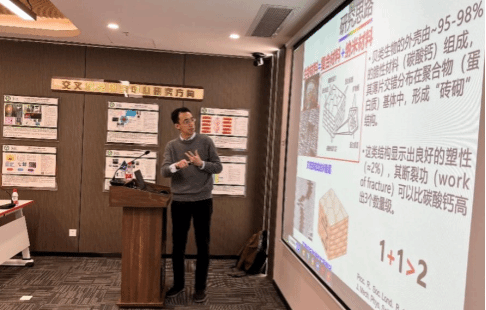
Professor Guo Qiang introduced recent research progress in the field of graphene-reinforced metal matrix composites, with a focus on the structure and properties of the graphene-metal interface. Owing to their excellent intrinsic mechanical properties, graphene materials are regarded as ideal reinforcement candidates for the next generation of metal matrix composites. In particular, because the intrinsic structure of graphene can be precisely tailored with relative ease by tuning the type and content of its inherent defects, graphene-reinforced metal matrix composites can exhibit continuously adjustable mechanical and functional properties. Drawing inspiration from the "brick-and-mortar" structure of mollusk shells and adopting the design concept of "biomaterials = composites + nanomaterials," Professor Guo's team fabricated graphene-reinforced aluminum matrix composites (RGO-Al). Their research specifically revealed that the graphene reinforcement not only enhances the strength of the composite through a load-bearing effect, but also engages in complex interactions with dislocations within the metal matrix during the deformation process, thereby influencing or altering the deformation mechanisms of the matrix and imparting additional strengthening and toughening effects to the composite.
After the report, the attending faculty members engaged in lively exchanges and discussions with Professor Guo Qiang on topics including the research techniques and methods mentioned in the presentation, as well as the strengthening and toughening mechanisms of the composite materials.
Introduction to Professor Guo Qiang:
Professor Guo Qiang received his bachelor's degree from the School of Electronics Engineering and Computer Science at Peking University in 2005 and his master's degree from the Department of Materials Science and Engineering at the Massachusetts Institute of Technology (MIT), USA, in 2006. From 2006 to 2010, he pursued his Ph.D. in Advanced Materials under the Singapore-MIT Alliance at the National University of Singapore, during which time he served as a Research Assistant in the Department of Materials Science and Engineering at MIT from March 2009 to March 2010. From 2010 to 2012, he was a Postdoctoral Researcher in the Department of Applied Physics and Materials Science at the California Institute of Technology, USA. Since October 2012, he has served as a Distinguished Researcher, Tenured Associate Professor, and Professor at the State Key Laboratory of Metal Matrix Composites and the School of Materials Science and Engineering at Shanghai Jiao Tong University. He has published over 100 research papers in domestic and international academic journals such as Science, Science Advances, Nano Letters, and Acta Materialia, with over 4,500 SCI citations. He has led eight national, provincial, and ministerial-level projects, including those under the National Key Research and Development Program and the National Natural Science Foundation of China. In 2012, he was selected for the National High-Level Overseas Young Talent Program; in 2013, he was selected for the Shanghai Pujiang Talent Program; and in 2018, he received the Tang Lixin Outstanding Scholar Award from the Tang Lixin Education Foundation.
Draft: Chen Bin
First Review: Liu Zhao / Second Review: Li Runxia / Final Review: Wang Biao